
Mixing & scale-up
Why Kitchen Recipes Fail at Scale: The Science of High-Shear Liquid Mixing
The Filling Lab, Bolton - Contract manufacturing for beauty, personal care, and wellness brands.
For independent beauty, personal care, and wellness founders, the transition from home production to commercial scale is an exciting milestone. However, it's also the exact moment many stable kitchen or small-scale lab recipes completely fall apart.
A formulation that looks beautifully thick, glassy, and uniform when whisked by hand in a 2-litre glass bowl frequently separates, turns cloudy, or clumps into a ruined mess when scaled up to a 100-litre industrial batch.
This isn't a failure of your recipe - it's a failure of physics. To scale up a liquid product successfully, you have to understand how raw ingredients behave under commercial plant equipment.
The Trap of Raw Thickeners and “Fish-Eyes”
When creating modern cosmetic gels, serums, or thick emulsions, raw gelling agents and polymers (such as Carbomer 940, Xanthan Gum, or Hyaluronic Acid) are standard ingredients. In small kitchen batches, you have the luxury of time to slowly sift, hydrate, and meticulously hand-mix these powders into water.
When you scale that up to a commercial tank, standard paddle mixers or slow-moving blenders fail. Because these powders are highly hydrophilic (water-loving), the outer layer hydrates instantly upon touching water, forming a tough, rubbery skin around a dry core of powder.
In the manufacturing industry, these are known as “fish-eyes.” No amount of standard stirring will break them down. You end up with a watery batch filled with gelatinous lumps that will plug up retail bottle pumps and separate on store shelves.
The Solution: High-Shear Mechanical Dispersion
To blend thick polymers uniformly without ruining the batch, you cannot rely on simple turnover. You need intense mechanical force.
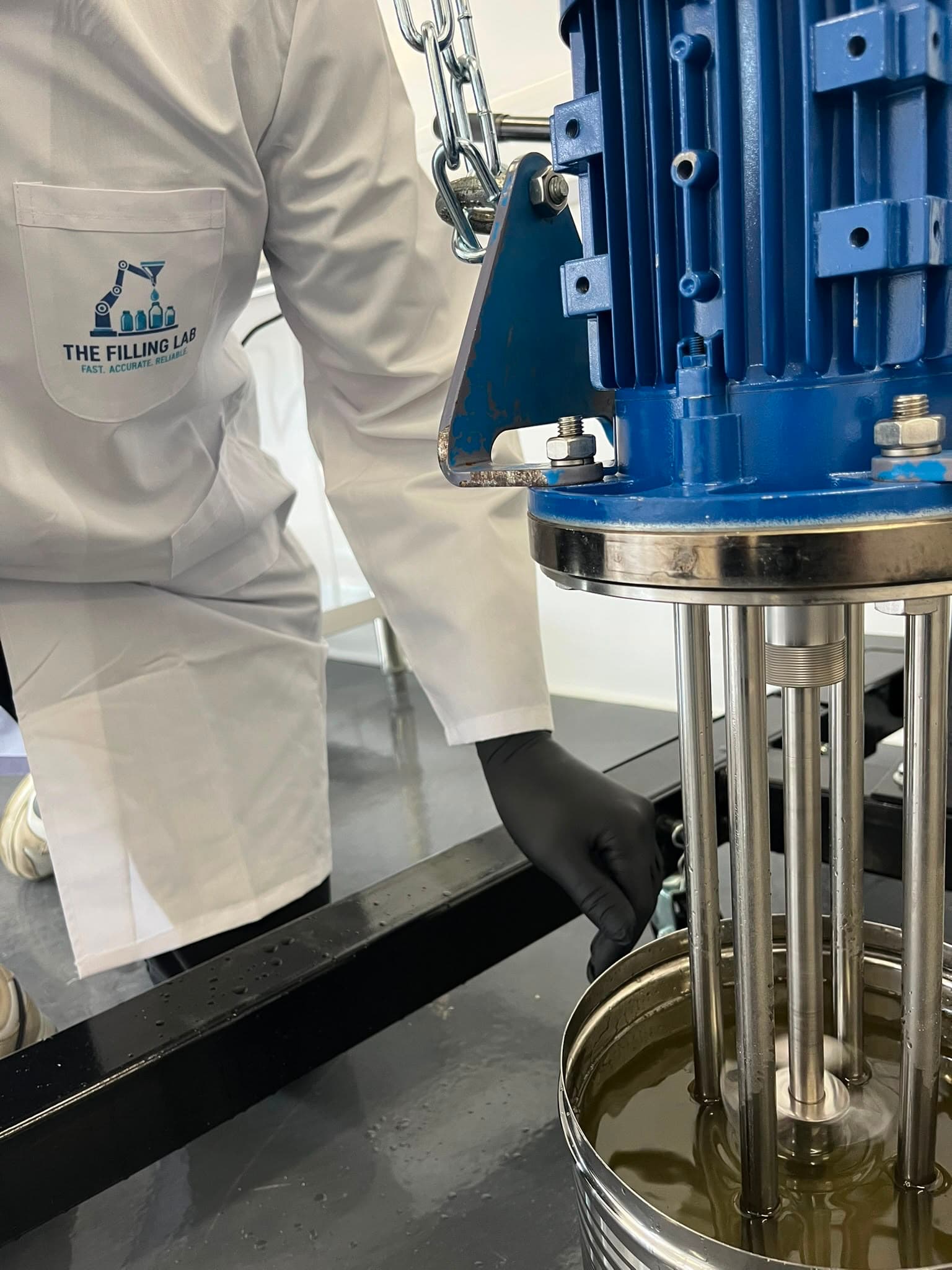
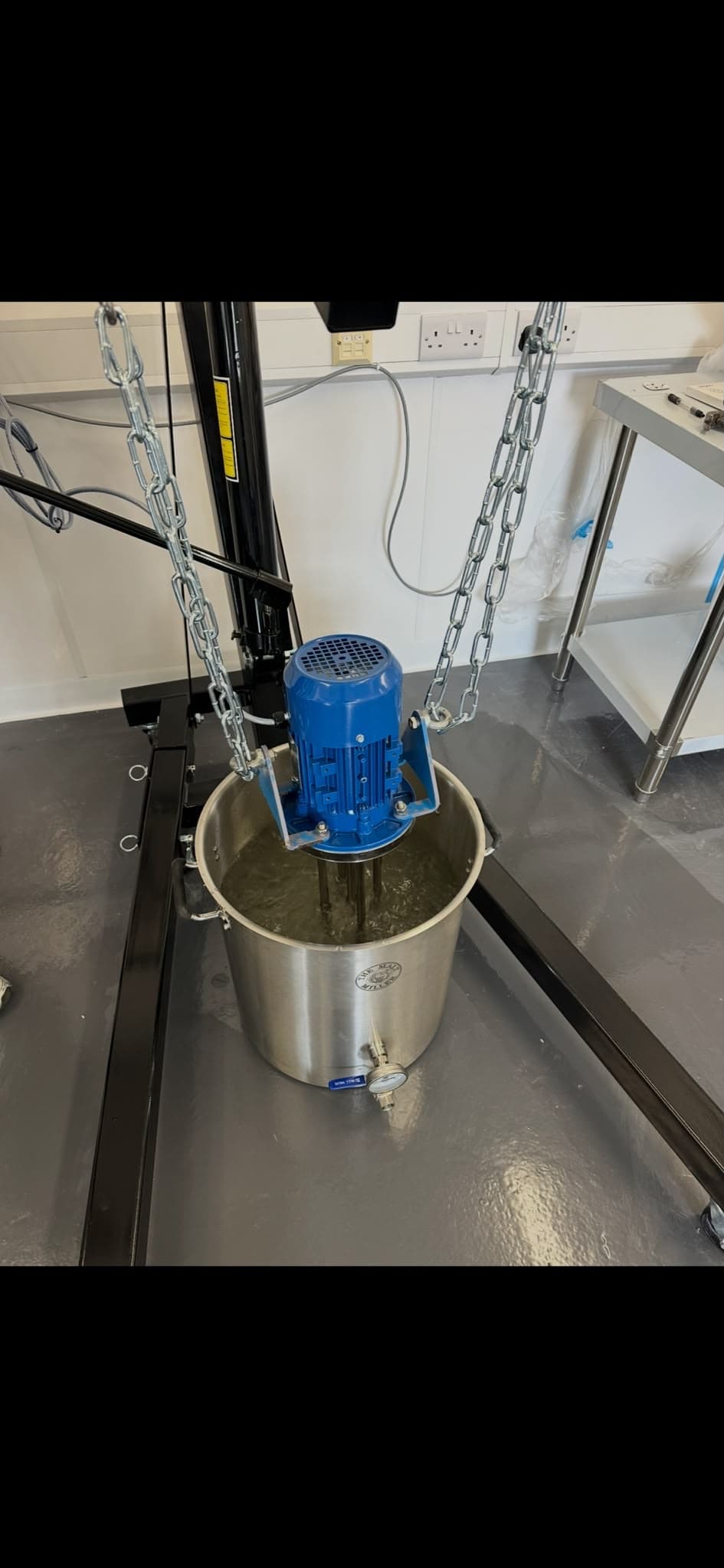
At The Filling Lab in Bolton, we solve this by utilizing advanced Silverson high-shear mixing technology.
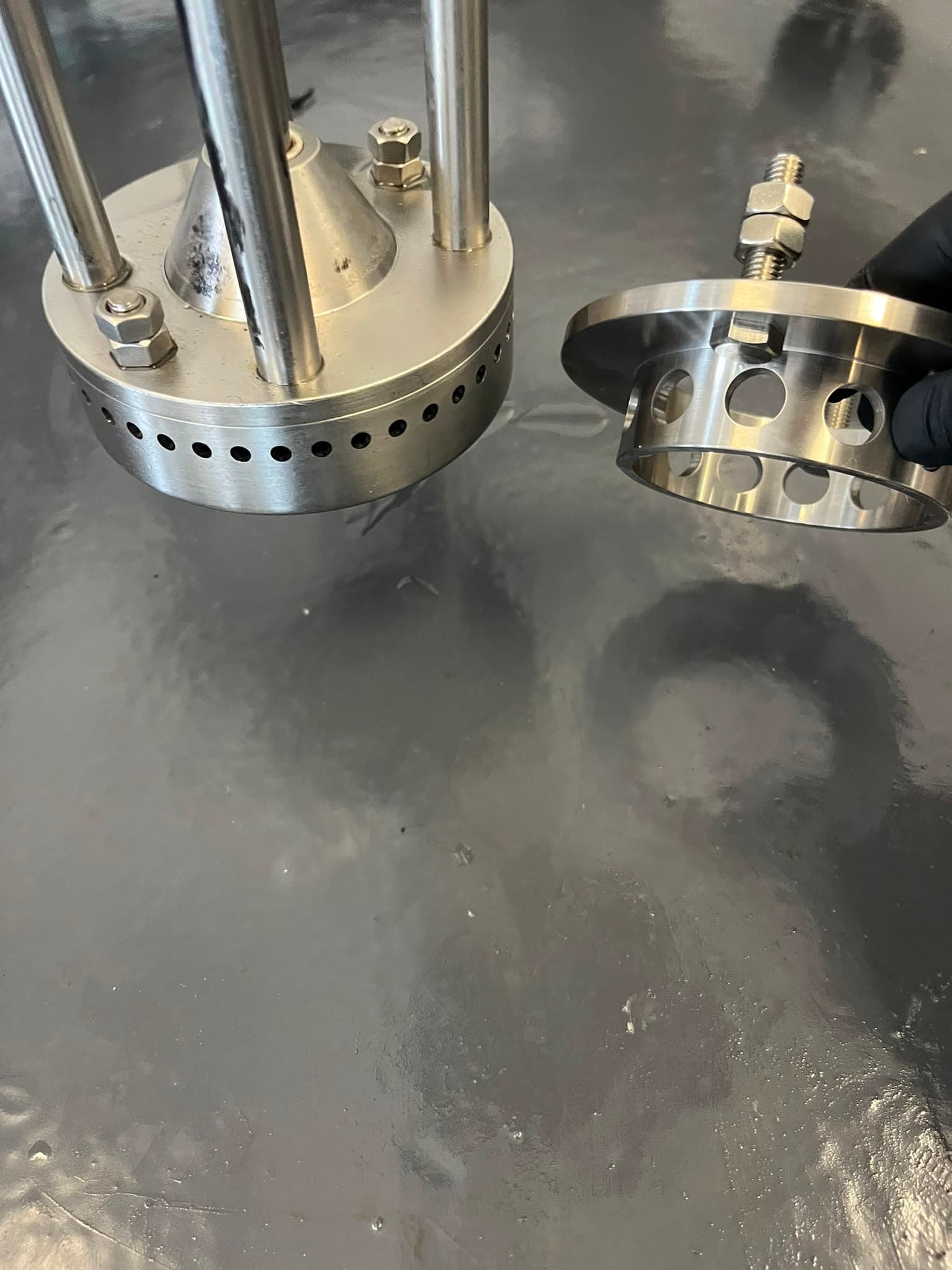
Unlike a standard propeller blade that just pushes liquid around a tank, a high-shear mixer features a high-speed rotor spinning inside a fixed stator head. The liquid and raw powders are violently sucked into the mixing head at thousands of RPMs. The rotor blades accelerate the ingredients to the outer edge of the stator, where they are mechanically sheared and pulverized through precise perforations.
This action breaks down raw particles at a molecular level, forcing total hydration in a fraction of a second.
High-shear dispersion on plant kit - Rotor-stator action for total hydration without kitchen-scale shortcuts.
The Aeration Dilemma: Controlling the Variable Frequency Drive (VFD)
But high speed introduces a new manufacturing problem: trapped air.
If you run a high-shear mixer at maximum velocity without precision control, you will whip millions of microscopic air bubbles into the fluid. While this might look frothy and interesting in a kitchen blender, in a retail bottle it looks cloudy, cheap, and alters the actual fill-volume of your product. As the bubbles slowly rise and escape over weeks on a shelf, your 100ml bottle will suddenly look only 80% full.
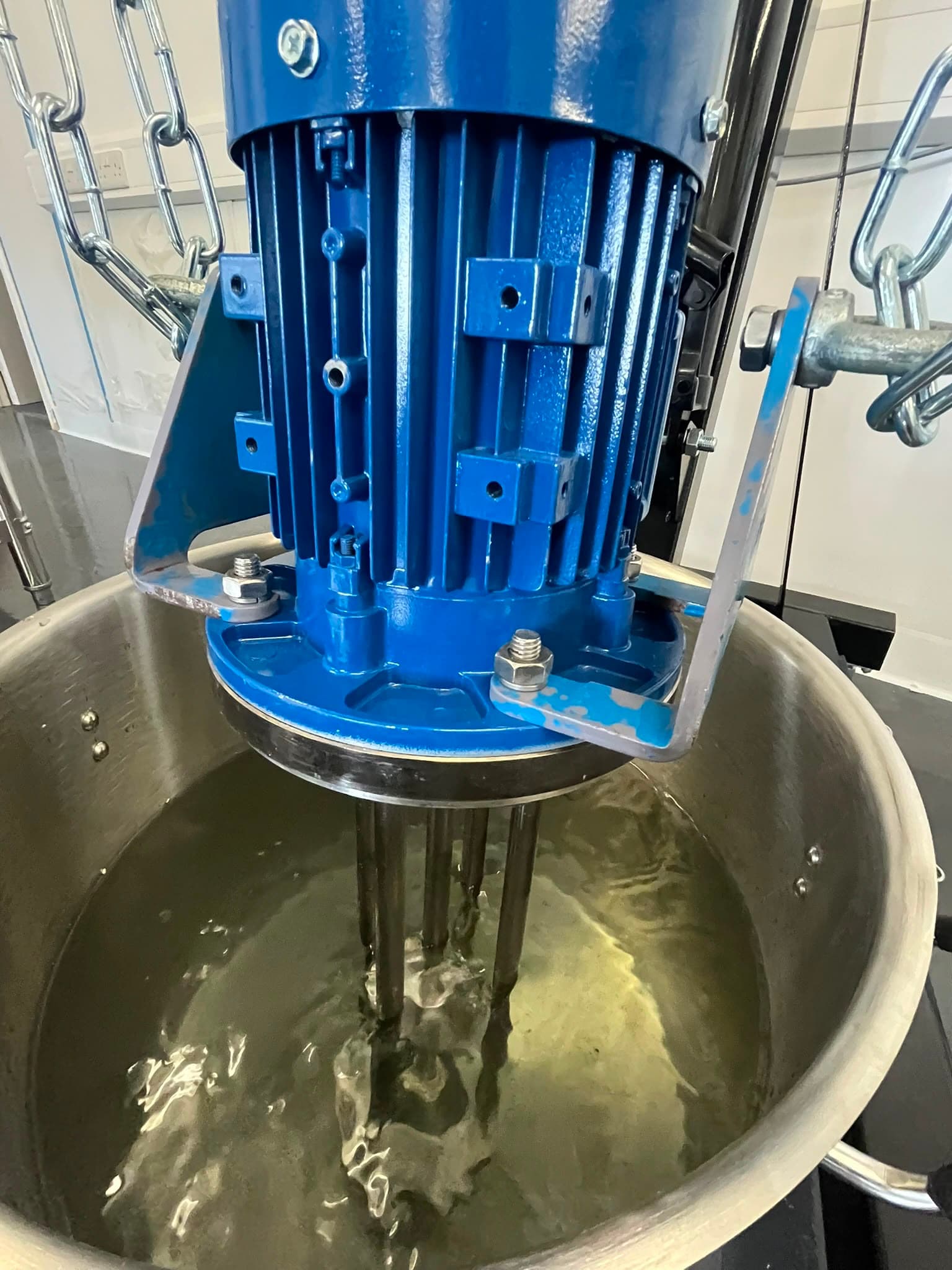
Managing this requires precise electronic control. By pairing our high-shear plant kit with wall-mounted Variable Frequency Drives (VFDs), our line operators can micro-adjust the exact frequency (Hz) and rotation speed of the batch in real-time. This allows us to hit the perfect aesthetic sweet spot: achieving maximum particle breakdown and flawless emulsion stability while keeping the gel crystal-clear, smooth, and entirely de-aerated.

The Takeaway for Growing Brands
Scaling a product is never as simple as multiplying your kitchen recipe by 50 or 100. It requires translating a bench-top concept into a disciplined, industrial workflow.
If you are tired of fighting with lumpy batches, trapped air, or separating formulas, it's time to move out of the kitchen. Partnering with an agile contract manufacturer equipped with high-shear plant infrastructure ensures your product hits retail shelves with the exact same premium look and stability every single time.